


Navigating Ontario's Spring 2026 Economic Shift: Smart Staffing for Uncertain Forecasts
How should GTA industrial employers manage labour in Spring 2026?
Given Ontario's sluggish GDP growth and the federal government's sharp reduction of new temporary resident arrivals, employers should prioritize flexible labour. Partnering with an Employer of Record (EOR) like Alliance Employment Services allows facilities to meet unpredictable production spikes without committing to long-term payroll liabilities.
What is causing the GTA industrial labour squeeze in 2026?
The primary driver is the federal 2026-2028 Immigration Levels Plan, which significantly reduced new temporary resident targets. For warehouses and manufacturers in Mississauga, Brampton, and Vaughan, fewer incoming international students and temporary workers mean a more competitive, shrinking applicant pool for industrial roles.
- 155,000 new student arrivals — 49% fewer than last year's target
- 230,000 new temporary worker arrivals — 37% fewer than last year's target
The government's broader goal is to reduce the temporary resident population to under 5% of Canada's total population.
Across the Greater Toronto Area supply chain, our recruiters at Alliance Employment Services are already seeing the downstream effects:
- Smaller applicant pools: Walk-in applications for general labour roles have noticeably thinned across Peel Region compared to the same period last year.
- Increased wage pressure: With fewer entry-level candidates available, base wage expectations are creeping higher just to attract talent.
- Turnover risk: Workers now have more leverage to move to neighbouring facilities for incremental pay bumps.
Why is flexible staffing the safest economic hedge this year?
Flexible staffing mitigates financial exposure during periods of economic uncertainty. By using temporary or temp-to-perm labour, industrial employers avoid the fixed overhead of full-time salaries and benefits — letting facility managers in Markham, Richmond Hill, and Scarborough scale their workforce based on actual weekly volume.
Committing to permanent, full-time headcount right now is a heavy gamble. If Q3 orders dip, you are left carrying the cost of idle workers or facing the expensive, morale-damaging process of layoffs.
The 3 Labour Staffing Models
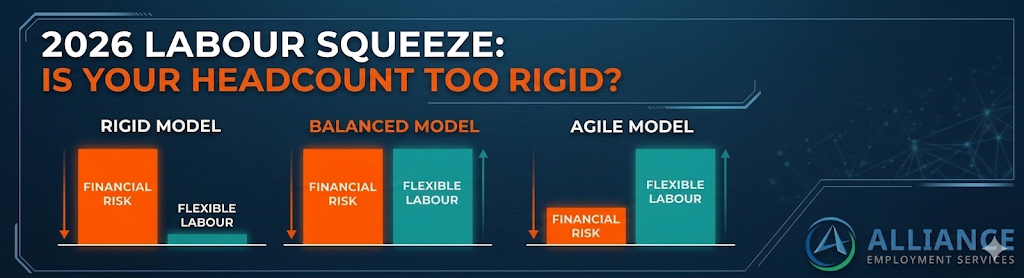
To weather Ontario's current economic climate, facility managers should audit their ratio of fixed headcount to flexible labour. We track three distinct staffing models operating across the GTA — but only one effectively protects profit margins this spring.
1. The Rigid Model
90% Full-Time Employees / 10% Flexible Labour
This is the traditional pre-2024 warehouse model. In the 2026 economy it is dangerous: you carry maximum WSIB liabilities, full ESA compliance burdens, and fixed payroll regardless of fluctuating volume. When container shipments are delayed at GTA rail yards, you pay for idle hands.
2. The Balanced Model
70% Full-Time Employees / 30% Flexible Labour
Better suited to seasonal spikes, but it still leaves employers exposed during sudden downturns. Internal HR teams remain bogged down by hiring administration, and WSIB premiums stay vulnerable to incidents within the large core group.
3. The Alliance Agile Model
40% Core Full-Time Leaders / 60% Flexible Alliance EOR Labour
The 2026 gold standard for facilities in Mississauga, Brampton, and Vaughan. You keep your specialized internal leadership and core operators (40%), while Alliance acts as Employer of Record for the remaining 60% — handling WSIB risk, ESA compliance, and payroll for the majority of your floor staff. You scale that 60% up or down with actual weekly throughput, achieving maximum agility with minimal liability.
The Burden-Shift: how does Alliance act as your operational shield?
When you partner with Alliance Employment Services, we become the legal Employer of Record (EOR), assuming responsibility for ESA compliance, payroll administration, and WSIB claims management. We shield your business from administrative noise and legal exposure, deploying vetted industrial workers to your facility in an average of just 3 hours.
For clients across Toronto and North York, this "Burden-Shift" is a game-changer:
If an injury occurs to one of our placed workers, the claim is managed through our WSIB account — helping protect your premiums and safety record.
We navigate the Ontario Ministry of Labour's 2026 hiring and job-posting regulations so your internal HR team doesn't have to.
Request 20 workers for a sudden Tuesday container offload and release them by Friday — paying only for the productive hours you use.
Frequently Asked Questions
How does the 2026 reduction in temporary residents affect my warehouse hiring?
New student arrivals are down 49% and temporary worker arrivals down 37% under the 2026-2028 plan, meaning fewer candidates for general labour and entry-level industrial roles. To secure reliable talent, GTA employers should lean on established staffing agencies with deep, pre-existing candidate pools.
What is an Employer of Record (EOR) and why do I need one?
An EOR is a third-party organization (like Alliance) that takes on the legal employment responsibilities for a workforce — payroll, taxes, WSIB, and ESA compliance — helping shield your business from many risks associated with direct hiring.
How fast can Alliance Employment Services deploy workers to my GTA facility?
Using our local candidate database and rapid-response protocol, we can typically deploy vetted, safety-trained industrial workers to facilities in Mississauga, Brampton, Vaughan, and surrounding areas within an average of 3 hours.
Can we use flexible labour to test workers before hiring them full-time?
Yes. Our temp-to-perm model lets you evaluate a worker's punctuality, skill, and cultural fit while they're on our payroll, before you commit to transferring them to your permanent headcount.
Build Your Agile Staffing Mix for 2026
Let's audit your fixed-to-flexible labour ratio and design a model that protects your margins through an uncertain year.
Book a Free Staffing Consultation Or call directly: (416) 892-6715 · Average 3-hour deployment · No long-term commitment